
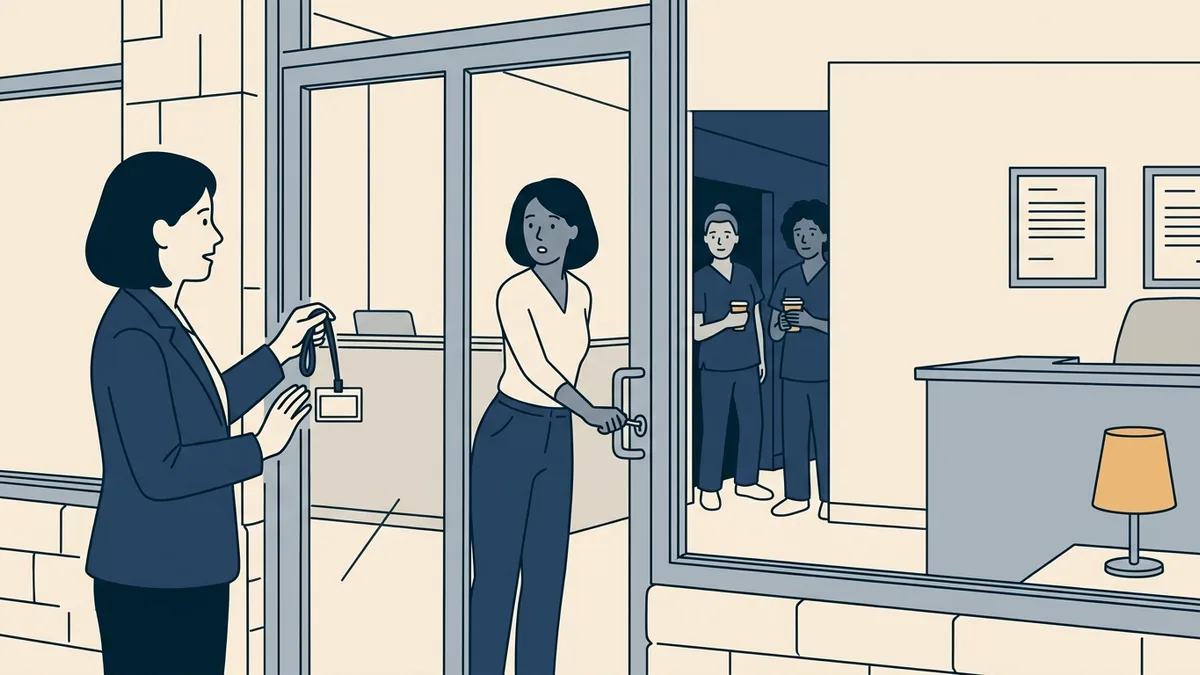
A useful mock survey copies CMS's surveyor guidance: arrive unannounced at opening time, request the same patient, staff and visit lists surveyors use, draw the Appendix B or Appendix M sample, observe home visits against the plan of care, score Level 1 standards first, and write findings and a plan of correction like a real statement of deficiencies.
Real Medicare surveys of home health agencies and hospices are unannounced, and they start from the patient list, not the policy manual. A mock survey that is scheduled a month ahead and spends the day reading policies tests the wrong thing. The best rehearsal copies CMS's surveyor guidance step by step: State Operations Manual Appendix B for home health agencies (Rev. 245, August 2026) and Appendix M for hospices.
Why should a mock survey be unannounced?
Because the real one will be. CMS's State Operations Manual explains the reason: if a provider "knows the exact or approximate date of a survey, it may temporarily adjust its typical practices," presenting "an unrepresentative picture" of the care it usually gives (SOM chapter 2, section 2005). The Social Security Act backs that up with civil money penalties for anyone who tips off a home health agency about a survey.
So only the owner or administrator who commissions the mock survey should know the date. Pick a day inside the agency's survey window and arrive at opening time. The first findings are often about the door: Appendix B tells surveyors that if the agency "is not open when the surveyor arrives, the SA should be contacted for further guidance," and Appendix M tells hospice surveyors not to "delay the survey because the administrator is not available." Record how long it takes to find someone who can let you in and start the entrance conference.
How should the entrance conference go?
Ask for exactly what a surveyor asks for, and time the answers. For a home health agency, Appendix B's standard survey list includes:
- the number of unduplicated skilled admissions in the past 12 months, from all payers and all locations;
- a list of active skilled patients with start-of-care dates, admitting diagnoses, services by discipline and any clinically complex treatments;
- the home visit schedule for the survey days;
- every patient discharged in the past six months;
- a list of direct and contracted employees with job titles and hire dates, the organizational chart, the admission packet, the complaint log and an abuse tracking log if one exists;
- an updated Form CMS-1572 by the end of the first day.
For a hospice, Appendix M adds the election dates, terminal diagnoses, location and level of care for each current patient, lists of live discharges and deaths, the interdisciplinary group meeting schedule and minutes, grievance logs, written agreements with every nursing home where the hospice has patients, and Forms CMS-417 and CMS-643 "within an hour of the entrance conference."
An agency that cannot pull these lists from its system in an hour has found its first fix.
Which patients and records should the mock sample include?
Use the surveyor's sample size, not a convenience sample. Appendix B's Table 2 sets the minimum by the agency's unduplicated skilled admissions in the past 12 months:
- fewer than 300: 2 closed records, 3 home visits with record review, 2 record-only reviews;
- 301 to 500: 3, 4 and 3;
- 501 to 700: 4, 5 and 4;
- 701 or more: 5, 7 and 5.
Stratify it the way CMS does: a range of admitting diagnoses and every discipline the agency provides, patients from the parent and every branch, all payer sources, and patients receiving complex services such as infusion therapy or wound care. Surveyors pick closed records partly from patients flagged on the Potentially Avoidable Event report, so use that report too.
For a hospice, Appendix M requires patients from each setting the hospice serves (private homes, nursing facilities, inpatient units, hospitals and assisted living), "at least one record from each multiple location," and a range of terminal diagnoses, including dementia, heart disease, cancer, respiratory disease, stroke and kidney disease.
What should the home visits test?
Federal rules say home visits are made "only with their consent," and their purpose is to evaluate whether the care furnished matches the patient's "written plan of care and clinical records" (42 CFR 488.710(a)(2)). Before each visit, read the plan of care. During it, watch whether the clinician does what the plan says, at the frequency it says, and whether the patient and family understand their rights, the plan and how to reach the agency. Afterward, check that the visit note matches what you saw.
The standard home health survey concentrates on "Level 1" standards in the conditions for patient rights, comprehensive assessment, care planning and coordination, infection prevention and control, skilled professional services, home health aide services, emergency preparedness, organization and administration, and clinical records (Appendix B, Table 1). Score the mock survey against those first. In a real survey, noncompliance with a Level 1 standard expands the survey to the whole condition, and substandard care triggers an extended survey of all 15 conditions within 14 days. See the home health conditions of participation in plain English.
How does a hospice mock survey differ?
Hospice care happens in more places and at more levels, and Appendix M builds both into the sample. Surveyors are told to include patients from three of the four levels of care: routine home care, continuous home care and general inpatient care. Appendix M describes continuous home care as care during "periods of brief crisis" that "must total a minimum of eight hours or more of care within a 24-hour period," and general inpatient care as care for pain and symptoms that home management cannot control, provided in "a Medicare certified hospice inpatient facility, SNF, or hospital that meets the 24-hour nursing requirement." Pull at least one record for each level the hospice has used in the past year and check that the documentation supports it.
Then follow the paper to the team. Surveyors ask where the interdisciplinary group meets and where its minutes are kept, and they compare those minutes with the plan of care and the visit notes. They ask for bereavement records for patients who died, and for the written agreement with each nursing home where the hospice has patients. A mock survey should do the same, and the mock surveyor, like a real survey team, should include a registered nurse with hospice experience. See the hospice conditions of participation in plain English.
Which files do surveyors ask for when a survey expands?
Appendix B lists additional items requested at the start of a planned extended survey or when a survey expands. Have them ready before you need them:
- home health aide training records, competency evaluations and in-service training;
- "the identity of, and governing body authorization for, the person who is authorized in writing to act on behalf of the administrator";
- quality assessment and performance improvement program activities and performance improvement projects, including infection control;
- the emergency preparedness plan.
The second item is easy to overlook, even though 42 CFR 484.105(b)(2) requires the pre-designated person to be "authorized in writing by the administrator and the governing body." Add your exclusion screening records to the stack while you are at it; see checking owners and managing employees against the LEIE and SAM.
After the mock survey, what comes next?
Write the findings the way a surveyor would on Form CMS-2567: the requirement, what was observed, and the evidence, without softening. Then write a plan of correction with an owner and a date for each finding, and check it 30 and 90 days later. Repeat the mock survey at least once a year, and again after any change in ownership, administration or management, since 42 CFR 488.730(b) allows a real survey within two months of such a change. For timing, see the 36-month recertification survey and how often hospices are surveyed.
Our Survey Readiness Plan ($1,500 per year) includes an annual unannounced mock survey run on this model, a written findings report, policy updates and a tracker for your survey window. For agencies preparing for initial accreditation once CMS reopens enrollment, Accreditation Readiness ($2,995) covers the policies, files and mock survey before the accrediting organization's visit. We prepare and coach. We never schedule, predict or influence a survey date, and we are not affiliated with CMS, any state survey agency or any accrediting organization.
Common questions
- How often should a home health agency run a mock survey?
- At least once a year, and again after a change in ownership, administration or management, since 42 CFR 488.730(b) allows a real survey within two months of such a change.
- What do surveyors ask for first at a home health agency?
- Unduplicated skilled admissions for the past 12 months, a list of active skilled patients, the home visit schedule, recent discharges, a staff list, the organizational chart, the admission packet and the complaint log, according to Appendix B.
- How many home visits does a home health survey include?
- Appendix B sets a minimum of 3 home visits for agencies with fewer than 300 unduplicated skilled admissions a year, rising to 7 for agencies with 701 or more.
- Should staff know the date of a mock survey?
- No. Real surveys are unannounced, and CMS says advance notice lets providers temporarily change their practices. Only the person who commissions the mock survey should know the date.
Need Help with Enrollment or Licensing?
We prepare your Medicare enrollment, accreditation survey and state licenses in the order CMS requires, for your official to sign, and track every one to a decision.